

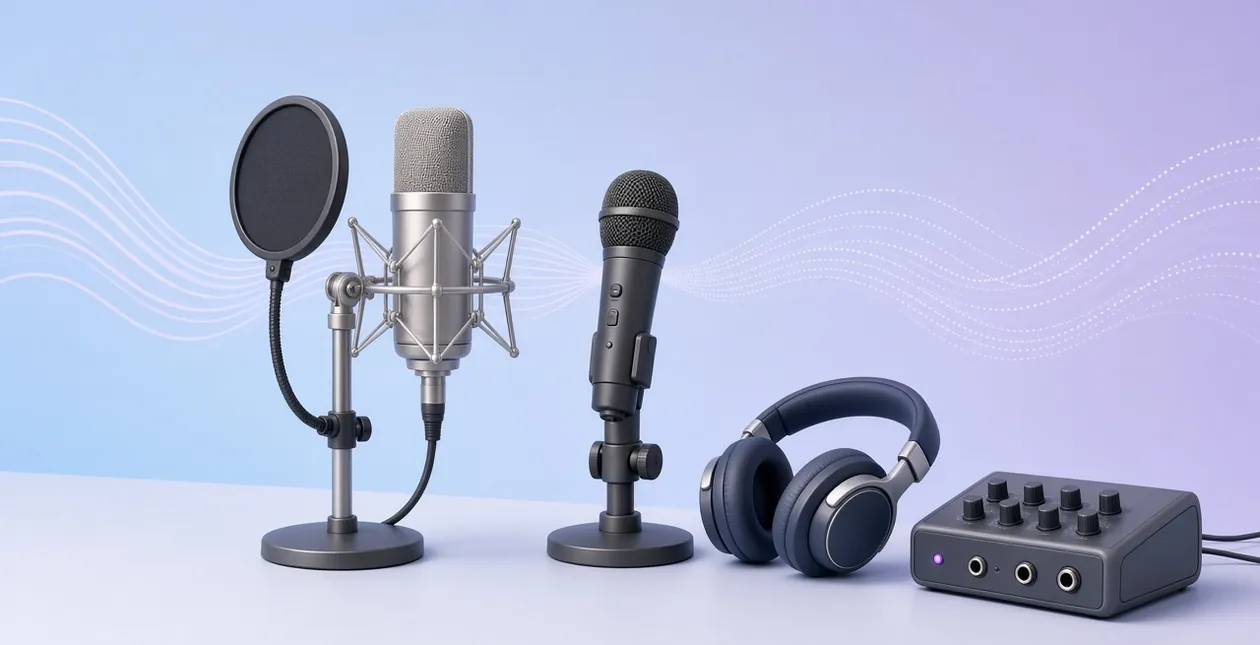
The condenser vs dynamic microphone choice mostly comes down to your room. A condenser catches more detail, including your fan and echo. A dynamic mic picks up less of the room when you work close, but it needs more gain.
On paper, Audio-Technica’s AT2020 condenser puts out almost nine times the signal of Shure’s SM58 dynamic.
How we checked: We read spec sheets and guides from Shure, Audio-Technica, Neumann and RØDE on November 25, 2026. No new recording test, so this is research-based. How we review software
Condenser vs dynamic microphone: what’s the real difference?
The short answer:
- Quiet room, singing or acoustic instruments: start with a condenser.
- Noisy or echoey room, podcasts, streams, live gigs: start with a dynamic.
- Either way: check that your interface can power or drive the mic before you buy it.
Both turn sound into an electrical signal. They just do it in different ways, and that one design choice explains almost everything else.
What is a dynamic microphone?
A dynamic mic is a tiny generator. Sound moves a diaphragm, a coil of wire attached to it moves inside a magnetic field, and that motion creates the signal.
Shure’s guide to mic transducers describes it as a diaphragm, a voice coil and a magnet.
Because it makes its own signal, a passive dynamic mic needs no power. It’s also hard to hurt. Shure says it would take a sound pressure level above 150 decibels to make a typical SM58 distort.
What is a condenser microphone?
A condenser mic is a capacitor. A very thin, conductive diaphragm sits close to a fixed metal backplate. When sound moves the diaphragm, the gap changes and so does the signal.
Neumann’s explainer notes that the British still call them capacitor microphones for that reason.
The capsule’s signal is too weak to send down a cable on its own, so every condenser has electronics inside. Those electronics need power, which is why condensers need phantom power, a battery or USB.
The lighter diaphragm is the whole point. It has less mass to move, so it reacts faster to quiet sounds and high frequencies. That’s the detail people pay for, and also the reason a condenser hears your keyboard.
How do condenser and dynamic mics compare side by side?
Here’s how the two types usually differ. “Usually” matters: there are condensers built for the stage and dynamics built for the studio.
| What you care about | Condenser | Dynamic |
|---|---|---|
| Sensitivity | High. Catches quiet detail and the room | Lower. Needs you close to the mic |
| Power | Phantom power, battery or USB | None for passive XLR models |
| Gain needed | Less | More, sometimes a lot more |
| Loud sources | Can overload on sudden peaks | Very hard to overload |
| Durability | More delicate | Built for drops and touring |
| Typical use | Studio vocals, acoustic guitar, voiceover | Live vocals, podcasts, guitar amps, drums |
Now the numbers behind the first row. These come straight from each maker’s spec sheet:
| Mic | Type | Sensitivity (1 kHz) |
|---|---|---|
| Audio-Technica AT2020 | Condenser | -37 dB (14.1 mV/Pa) |
| Shure SM58 | Dynamic | -56 dBV/Pa (1.6 mV) |
| Shure SM7B | Dynamic | -59 dBV/Pa (1.12 mV) |
In plain English: at the same volume, the AT2020 sends out about 19 dB more signal than the SM58 and 22 dB more than the SM7B. Your interface has to make up that difference with gain.
That’s why the “which is better” question has no single answer. More signal is great in a quiet room and a problem in a noisy one.
When is a condenser mic the better choice?
Pick a condenser when detail matters and you control the room. Audio-Technica’s own comparison recommends one for fine vocal detail in a quiet or acoustically treated space.
- Studio vocals. Breath, texture and the top end of a voice come through more clearly.
- Acoustic guitar, piano and strings. Shure points to condensers for acoustic guitar, stringed instruments and cymbals because they catch high-frequency detail and fast attacks.
- Voiceover and narration in a treated booth or a soft, quiet room.
- Tiny mics. Lavalier, headworn and gooseneck mics are almost always condensers, according to Shure, because the capsule can be made very small.
Recording vocals at home? Our guide to the best condenser microphones for singing under ₹10,000 compares five real options, from the AT2020 to plug-and-play USB kits.
Here’s the catch: a condenser records the room as faithfully as your voice. RØDE notes that condensers pick up background sound more readily and suit reflective or noisy spaces less well.
Before you buy a condenser: stand where you’ll record and listen for 30 seconds. Fridge hum, a ceiling fan, street noise or a hard, echoey wall will all end up on the track.
If you can hear them, fix the room first or start with a dynamic.
When is a dynamic mic the better choice?
Pick a dynamic when the room is noisy, the source is loud or the mic will get knocked around.
- Podcasts and streams in an untreated room. You speak close, so your voice stays loud compared with the room.
- Live vocals. The SM58 was built for the stage, with a pop filter in the grille and a shock mount to cut handling noise, per its user guide.
- Guitar amps and drums. Loud sources won’t overload it.
- Handheld use. RØDE says dynamics are less prone to handling noise and rough treatment.
Streaming is a good example. If you’re setting up overlays and alerts with something like Streamlabs, a close dynamic mic keeps keyboard clicks and game audio lower in the mix.
Podcasters get the same benefit. Clean source audio also makes the next step easier, whether you edit by hand or feed episodes into an AI tool like Castmagic for transcripts and show notes.
What the spec sheet doesn’t say: low output means you need gain. Shure’s SM7B guide says it needs more than 60 dB of gain, which is more than most entry-level and mid-tier preamps provide.
Without it, you’ll need an inline preamp or a stronger interface.
Not every dynamic is that hungry. Shure says its MV7X works with almost any audio interface without extra gain. Check the sensitivity number before you buy.
What is phantom power, and do you need it?
Phantom power is DC voltage your mixer or interface sends up the same XLR cable that carries the audio. It powers the electronics inside a condenser mic.
The standard is P48: 48 volts over a normal 3-pin mic cable. Neumann invented it in the late 1960s, and it became the world standard.
Neumann’s U 87 Ai spec sheet lists it as 48 V ± 4 V under IEC 61938.
Do you need it?
- XLR condenser: yes. The AT2020 needs 48V phantom power, drawing about 2 mA.
- Passive XLR dynamic: no. Neumann says phantom power doesn’t affect dynamic mics that don’t need it.
- USB mic of either type: no. It takes power from the USB port.
- Tube condenser: it comes with its own power supply, because tubes draw more than phantom power can give.
Most audio interfaces have a 48V switch, sometimes one per input. If a condenser stays silent, check that switch before you blame the mic.
Does USB vs XLR change the answer?
It changes what else you buy, not which capsule type suits your room. Audio-Technica points out that both condensers and dynamics come in USB versions.
USB mics have the preamp and converter built in. You plug into a computer and record. Audio-Technica’s AT2020USB-X, for example, runs on USB power, records at up to 24-bit/96 kHz and has a headphone jack with a mix control.
XLR mics need an audio interface or mixer. That costs more up front, but you can upgrade the mic or the interface later without replacing both.
A simple rule:
- One voice, one computer, no plans to grow: USB is fine.
- Music, two or more people, or upgrades later: go XLR and choose an interface with enough clean gain for your mic.
Either way, you’ll record into software. Our roundup of song editing and mixing software covers free and paid options, from Audacity-style editors to full DAWs.
Making music from scratch? Pair your mic with one of these picks of software to create beats and loops, so the vocal has something to sit on.
Which microphone myths can you safely ignore?
“Dynamic mics cancel background noise.” They don’t. They’re less sensitive, so you work closer, and your voice ends up much louder than the room.
Audio-Technica is clear that a cardioid pattern doesn’t make any mic immune to its surroundings.
Back a dynamic off and it hears the room too. Shure’s SM58 guide says that at 3 to 6 feet away, you get a thinner sound with noticeable ambient noise.
“Condensers are always better.” Better at detail, yes. In a bare bedroom, that detail includes the echo. A dynamic in the same room often gives a cleaner result.
“Condensers can’t handle loud sounds.” Many can. The AT2020 is rated to 144 dB SPL. The real risk, as RØDE explains, is that a sudden loud peak can overload your interface input because of the higher output.
“Closer is always better.” Not quite. Cardioid mics add bass as you get closer.
Shure’s SM58 guide puts it at a 6 to 10 dB lift below 100 Hz at about a quarter of an inch, which is great for a radio voice and muddy for some singers.
Fair to both: Audio-Technica’s guide says room, placement and technique can matter as much as the mic type. A well-placed budget mic in a quiet room beats an expensive one in the wrong spot.
What if you don’t want to record your own voice?
Some projects don’t need a mic at all. For explainer videos, ads or quick narration, our guide to AI voice generator tools compares text-to-speech options, and our ElevenLabs review looks at one of the best-known in detail.
If you record screen tutorials, a tool like Camtasia records the screen and your narration together. A close dynamic mic usually works well there, because you’re talking over a noisy computer.
Need background music under that voice? Start with these resources for royalty-free music.
Condenser vs dynamic FAQs
Is a condenser or dynamic mic better for podcasting?
For most home podcasts, a dynamic mic is the safer start. You speak close to it, so your voice stays well above room noise and echo. A condenser can sound more detailed, but only in a quiet, soft room. Check that your interface has enough gain for the dynamic you choose.
Which is better for singing at home, condenser or dynamic?
In a quiet room with soft furnishings, a condenser usually captures more of a voice’s detail and air. In a noisy or echoey room, a dynamic often gives a cleaner take because you sing closer to it. Many singers own one of each and pick per song or per room.
Can I plug a condenser mic straight into my computer?
Only if it’s a USB condenser, which has its own preamp and converter and takes power from the USB port. An XLR condenser like the AT2020 needs an audio interface or mixer that supplies 48V phantom power. The interface then connects to your computer by USB.
Will phantom power damage a dynamic microphone?
Not a standard passive dynamic mic. Neumann, which developed P48 phantom power, says it does not affect dynamic microphones that don’t need external power. Even so, switch phantom power on only for the inputs that need it, and check the manual of any unusual or vintage mic first.
Why is my dynamic mic so quiet?
Dynamic mics put out a small signal, so they need more gain. Shure’s SM7B, for example, needs more than 60 dB of gain, which many entry-level interfaces can’t provide. Turn the input gain up, speak a few inches from the mic, or add an inline preamp.
Do condenser mics pick up more background noise?
Yes, in practice. Condensers are more sensitive, so at the same distance they record more of the fan, traffic and room echo. Cardioid patterns reduce sound from the back and sides, but they don’t block it. Recording closer and treating the room helps either type.
Are USB microphones condenser or dynamic?
They can be either. Audio-Technica points out that USB versions exist in both categories. The AT2020USB-X is a USB condenser, for example. Read the product page for the words condenser or dynamic, and pick based on your room, the same way you would with an XLR mic.
What does large-diaphragm condenser mean?
It’s a condenser with a bigger capsule membrane, the classic studio vocal mic shape. RØDE says there’s no strict standard, but a diaphragm of 1 inch (25.4 mm) or more is usually called large. Small-diaphragm condensers are common on acoustic guitar, piano and cymbals.
Which mic should you buy first?
Decide by room first, then by use. In the condenser vs dynamic microphone debate, the room wins more often than the spec sheet.
- Buy a condenser if you sing or record acoustic instruments in a quiet, soft room, because you’ll actually hear the extra detail.
- Buy a dynamic if you podcast, stream or record in a noisy, echoey space, because working close keeps your voice ahead of the room.
- Choose USB if it’s one voice into one computer, and XLR if you want to grow or record music.
- Check the gain if you pick a low-output dynamic like the SM7B: plan for more than 60 dB of clean gain.
Our pick for most first-time home recorders: a dynamic mic, unless your room is already quiet. Singers with a quiet room should start with our condenser mic picks for singing.




[…] choosing that mic? Our condenser vs dynamic microphone comparison explains which type works in a home room and what your interface needs to drive […]